By Benjamin Ibarra
Mayor Eric Adams announced the start of the public review process for the Jamaica Neighborhood Plan, an initiative aimed at injecting millions in investment and creating thousands of new homes in Jamaica, Queens.
The plan projects the creation of 7,000 jobs for Jamaica residents, who currently face some of the city’s longest commute times. It also proposes the development of 12,000 new homes, with approximately 4,000 designated as permanently low-income restricted affordable units. An additional $300 million will be allocated for crucial sewer infrastructure upgrades.
Over the past two years, the Jamaica Neighborhood Plan has actively engaged the community through 20-plus events to gather input. Now, the proposal will undergo a seven-month review involving stakeholders, the community board, the borough president, the City Planning Commission, and the City Council for finalization.
“A home is more than just four walls and a roof — it’s the foundation needed to achieve the American Dream and thrive in the greatest city on the globe,” stated Mayor Adams in the press release, emphasizing the plan’s potential to improve the lives of Jamaica residents for generations. Adams is currently seeking reelection.
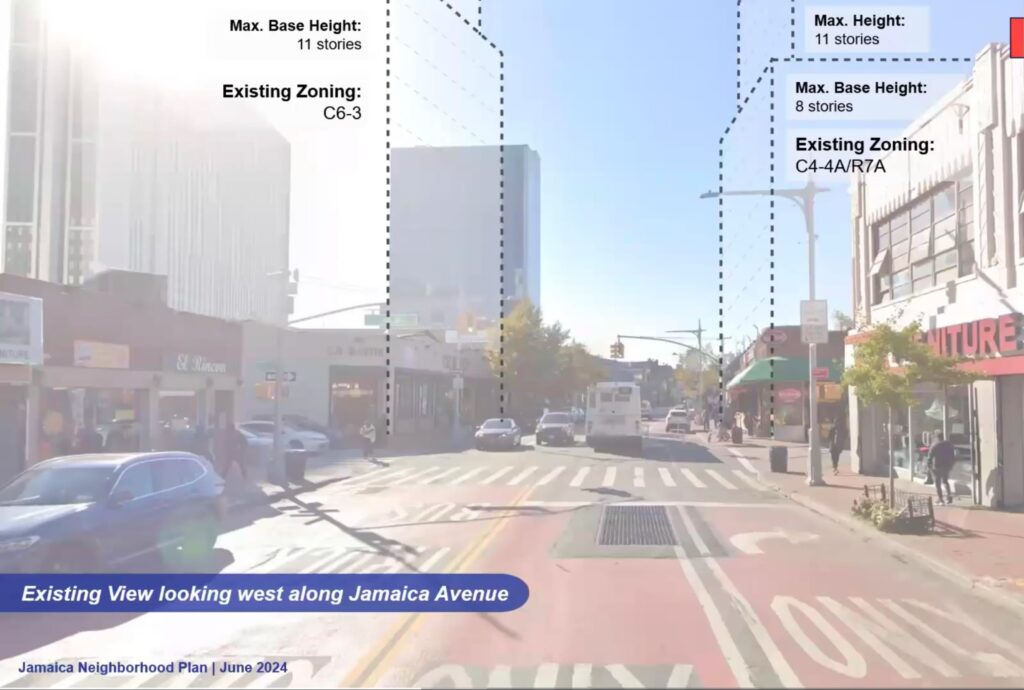
According to a Jamaica Neighborhood Town Hall presentation, the plan is driven by a 13.4 percent population increase in Jamaica between 2010 and 2020 (compared to the city’s 7.4 percent growth), while housing production only rose by 10 percent. The plan addresses the pressing need for affordable housing. Currently, over half of Jamaica’s residents are rent-burdened, with housing considered affordable only if it constitutes no more than a third of one’s income.
If approved, the proposal will enable new zoning regulations, community services and programs, and vital capital projects in Jamaica. The Draft Zoning Framework, presented at a town hall nine months prior, is a key component in laying the groundwork for these potential improvements.
The plan outlines specific zoning adjustments. The “Downtown Core” area will have optional participation in low-income housing development, with new zoning encouraging mixed-use residential and business buildings up to 23 stories.
Most single-home areas will remain un-rezoned. The focus for increased density will be on wider corridors such as Guy Brewer Blvd—which cuts through the York College campus—and Merrick Boulevard, allowing for residential buildings up to 11 stories.
Along Hillside Avenue and portions of Liberty and Jamaica Avenues, rezoning will permit 14-story residential buildings. These areas benefit from wider streets and proximity to major transportation hubs and shopping districts.
Notably, developments outside the Downtown Core will be required to dedicate 20-30 percent of their units to meet affordable housing requirements.
“It’s a good thing providing more homes, and it will be good for business,” said Abhay Singh, an employee at Pinoy Ako, a convenience store on Hillside Avenue.